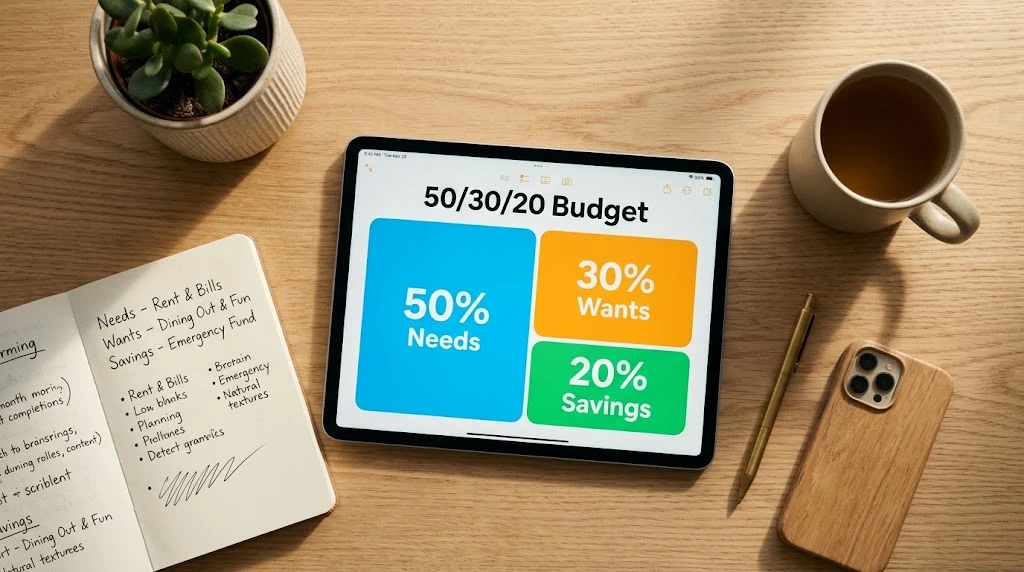
What Is the 50/30/20 Budgeting Rule? A Simple Way to Manage Money
Want to manage your money without stress? Download our Free Monthly Budget Planner Excel Template to apply the 50/30/20 rule instantly!
Managing your finances doesn’t have to mean tracking every single penny or feeling guilty about every coffee you buy. If traditional budgeting feels like a second job, you need a system that gives you boundaries without suffocating your lifestyle.
Enter the 50/30/20 budgeting rule. Coined by Senator Elizabeth Warren in her book All Your Worth, this is widely considered one of the most practical and intuitive frameworks for building a personal budget that actually works.
Instead of dealing with dozens of tiny categories, it simplifies your entire financial life into three broad buckets: Needs, Wants, and Savings. Let’s break down exactly how it works, how to calculate your numbers, and how to apply it to your life starting today.
How the 50/30/20 Rule Splits Your Income
The magic of this rule lies in its simplicity. Every dollar of your after-tax, take-home income is divided into three distinct categories:
+-------------------------------------------------------------+
|                      50/30/20 RULE                          |
+-------------------------------------------------------------+
|    50% NEEDS      |       30% WANTS      |    20% SAVINGS   |
|  Rent, bills,     | Dining out, travel,  |  Savings, debt,  |
|  essential food   |  shopping, hobbies   |   emergencies    |
+-------------------+----------------------+------------------+
1. 50% for “Needs” (The Must-Haves)
Needs are the essential expenses you absolutely must pay to keep your life running. If you stopped paying these, you would face serious consequences.
This includes:
- Housing: Rent or mortgage payments.
- Utilities: Electricity, gas, water, and essential internet.
- Transportation: Car payments, insurance, fuel, or public transit.
- Insurance: Health, life, and auto insurance.
- Basic Groceries: Everyday food items (excluding expensive dinners out).
- Minimum Debt Payments: The minimum required payments on credit cards, student loans, or personal loans.
2. 30% for “Wants” (The Nice-to-Haves)
Wants are expenses that enhance your life but aren’t strictly necessary for survival. This is the “fun” bucket, and it’s the most important category for making a budget sustainable.
This includes:
- Dining Out: Takeaways, restaurants, and morning coffees.
- Entertainment: Movie tickets, concerts, and streaming services (Netflix, Spotify, etc.).
- Shopping: New clothes, gadgets, and home decor.
- Hobbies & Travel: Vacation savings, gym memberships, and weekend activities.
3. 20% for “Savings” & Debt Paydown (The Future-proofing)
This final category is dedicated to your financial future and building security.
This includes:
- Emergency Fund: Building 3 to 6 months of living expenses.
- Retirement Contributions: 401(k), IRA, or other pension plans.
- Investing: Stock market, index funds, or property saving.
- Accelerated Debt Payoff: Any payments beyond the minimum required (such as paying extra toward high-interest credit cards to get out of debt faster).
Step-by-Step: How to Calculate Your 50/30/20 Numbers
Let’s look at a practical example. Suppose your monthly take-home (net) income is $4,000 after taxes and payroll deductions. Here is how your money should be distributed:
- Your Needs (50%): $4,000 × 0.50 = $2,000
- Your Wants (30%): $4,000 × 0.30 = $1,200
- Your Savings (20%): $4,000 × 0.20 = $800
With this split, you have $2,000 to cover your essentials, $1,200 to spend guilt-free on entertainment and lifestyle, and $800 to securely save or invest.
Why Is This Rule So Popular?
- It’s Incredibly Simple: No more over-categorizing. Is it essential for survival? If yes, it’s a Need. Is it just for fun? It’s a Want.
- Built-In Freedom: Unlike “scarcity” budgets, this system specifically allocates 30% of your money for guilt-free fun. You don’t have to feel bad about lifestyle spending, as long as it fits your 30% cap.
- Prioritizes Your Future: By automating your 20% savings, you build long-term wealth without having to think about it every day.
How to Handle Common 50/30/20 Challenges
“My Needs are way more than 50%!”
If you live in a high-cost-of-living area, your rent and essentials might consume 60% or 70% of your pay. Don’t panic. Treat the 50/30/20 rule as an ideal target rather than a strict rule. If your Needs require 65%, adjust your split to 65/20/15 or 60/25/15. The goal is to optimize over time by either cutting Needs (like downsizing or renegotiating bills) or gradually reducing Wants.
“I don’t know if something is a Want or a Need.”
Ask yourself: “What happens if I don’t pay this for three months?” If the answer is “I’ll lose my home” or “my electricity will go off,” it’s a Need. If the answer is “I will be bored” or “I’ll miss the latest show,” it’s a Want.
Take the Next Step: Try It Today
The easiest way to see where you stand is to plug your income and bills into a tracking system. Grab our Free Monthly Budget Planner Excel Template—it has built-in 50/30/20 guidelines to automatically calculate your exact Needs, Wants, and Savings targets based on your unique take-home pay.
Related Reading:
Learn the complete fundamentals of budgeting in our ultimate guide: How to Make a Personal Budget That Works.