Muslim Scientists Biographies: Free Learning Guide
Most history and science textbooks take a strange leap: they jump from classical antiquity directly into the European Renaissance as if nearly a thousand years of scientific inquiry simply never happened.
In reality, the foundational principles of modern algebra, clinical medicine, surgical instruments, optics, and mechanical engineering were researched, documented, and tested by visionary scholars across Baghdad, Cairo, Córdoba, and Damascus.
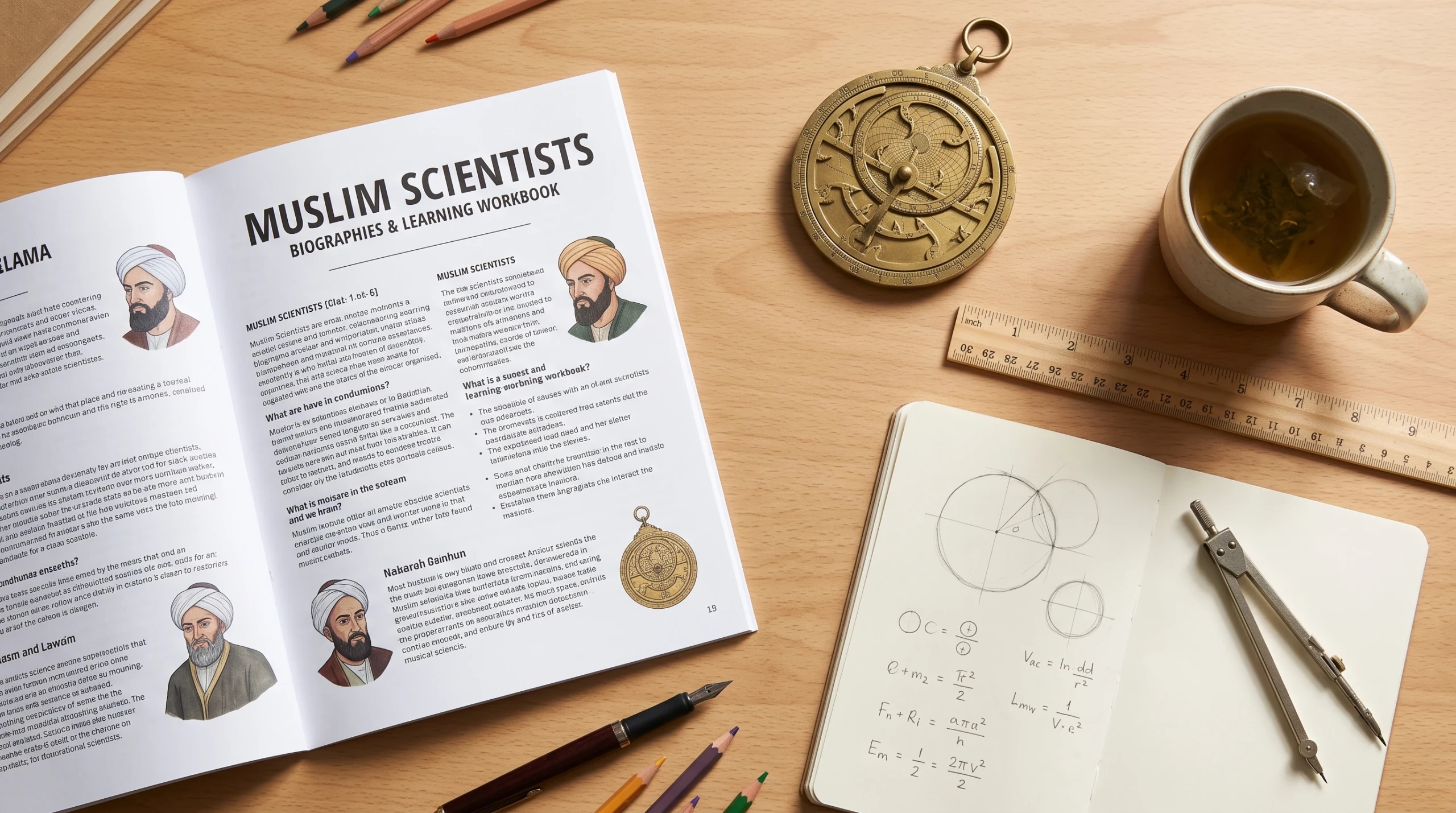
Whether you are teaching a history unit, looking for homeschool STEM enrichment, or wanting your children to connect with scientific heritage, this printable Muslim Scientists Biographies & Learning Workbook makes history accessible, structured, and engaging.
📥 Get Your Free Printable Workbook
What Makes This Workbook Practical & Effective?
This workbook moves beyond trivia to give learners a clear grasp of early scientific progress:
- 10 Curated Polymath Profiles: Explores the real breakthroughs of Al-Khwarizmi, Al-Battani, Omar Khayyam, Ibn Sina, Al-Razi, Al-Zahrawi, Ibn al-Haytham, Al-Jazari, Al-Idrisi, and Ibn al-Baytar.
- “Why It Matters” Context: Each biography highlights the scholar’s exact discovery alongside its enduring legacy in modern mathematics, healthcare, and engineering.
- Century-by-Century Timeline: Features a quick visual chronological recap from the 800s to the 1200s, helping students map historical developments in proper context.
- Active Recall Student Activities: Includes comprehension questions and an inquiry prompt on why observation and experimentation drive the scientific method.
- Turnkey Teacher Key: A ready-to-use answer key and reflection prompt save preparation time for educators and parents.
How to Use It for the Best Results
- Assign a Scientific Discipline: Focus on one branch at a time—pair mathematics and astronomy (Al-Khwarizmi, Al-Battani, Khayyam) with regular math studies, or explore medicine and optics (Ibn Sina, Al-Zahrawi, Ibn al-Haytham) during biology and physics units.
- Track the Historical Timeline: Have students follow the timeline on page 5 to trace how early algebraic treatises later connected to medical compendiums and mechanical inventions.
- Complete the Learning Review: Use the 8-question activity sheet on page 6 as an open-book quiz or discussion prompt.
- Facilitate the Personal Reflection: Ask learners to pick the scholar whose discoveries sparked their curiosity most and outline an experiment or field they want to investigate further.
Who Is This For?
- Homeschooling Families: A self-contained, print-and-go history and science unit study for learners aged 11 and up.
- Middle & High School Educators: Ready-made supplementary reading to enrich world history, Islamic studies, and STEM history curricula.
- Islamic Sunday Schools: An engaging resource to introduce youth to classical heritage in science, medicine, and critical thinking.
- Curious Young Readers: Independent learners who enjoy biographies of inventors, mathematicians, and pioneers.
Frequently Asked Questions
Which scholars are covered in this workbook?
The workbook profiles 10 major pioneers: Al-Khwarizmi (algebra/algorithms), Al-Battani (astronomy/trigonometry), Omar Khayyam (cubic equations/astronomy), Ibn Sina (clinical medicine), Al-Razi (medical diagnostics), Al-Zahrawi (surgery), Ibn al-Haytham (optics/scientific method), Al-Jazari (mechanical engineering), Al-Idrisi (cartography), and Ibn al-Baytar (pharmacology/botany).
What age group is this printable designed for?
The reading level and activities are tailored for ages 11 and older (middle school through early high school), though the biographies can be adapted for guided family discussions with younger children.
Does the workbook come with solutions?
Yes. Page 7 includes a full answer key for all eight comprehension questions along with guided reflection prompts for student evaluation.
Inspire the next generation of thinkers, scientists, and inventors with the enduring legacy of the Islamic Golden Age.